


Recently, the latest research from the lab of Professor Shuaillong Zhang, Chief Scientist of OptoSeeker Biotech, was published in the internationally recognized academic journal Proceedings of the National Academy of Sciences (PNAS). In the paper, Dielectric Levitation Optical Tweezers for Powerful Mesoscale Biomanipulation, Professor Zhang's team proposes dielectric-levitation optical tweezers (DL-OT), providing a new technical route for the precise manipulation of biological objects at the hundreds-of-micrometers scale.
OptoSeeker Biotech congratulates Professor Zhang's team and all collaborating researchers.
Original paper: https://doi.org/10.1073/pnas.2533103123
Extending the Biomanipulation Scale of Optical Tweezers through Dielectric Levitation
Optical tweezers use the optical force generated by a focused laser to capture and move small objects, and have important applications in the manipulation of particles, cells, and biomolecules.
However, when the targets expand to mesoscale biological structures such as multicellular spheroids and organoids, adhesion, static friction, and near-wall fluidic drag between the sample and substrate increase substantially. Continuing to overcome these forces by increasing laser power can produce greater photothermal stress, leading to sample deformation and reduced cell viability.
To address this limitation, Professor Shuaillong Zhang's team combined AC dielectric levitation with optical tweezers. The system uses negative dielectrophoretic force to lift the target away from the substrate and place it in a stable levitated state, after which optical tweezers provide lateral translation and rotation.
The key is not simply to increase the output of the optical tweezers, but to change the force environment around the sample. In stable levitation, solid contact and static friction between the sample and substrate are eliminated, while near-wall fluidic drag is substantially reduced. Mesoscale objects can therefore be manipulated at lower laser power.
To build the experimental system, the researchers used a holographic optical-tweezers module together with a customized microfluidic chip, AC-field control, and biological-sample validation, completing the construction and experimental evaluation of a dielectric-levitation optical-tweezers system.
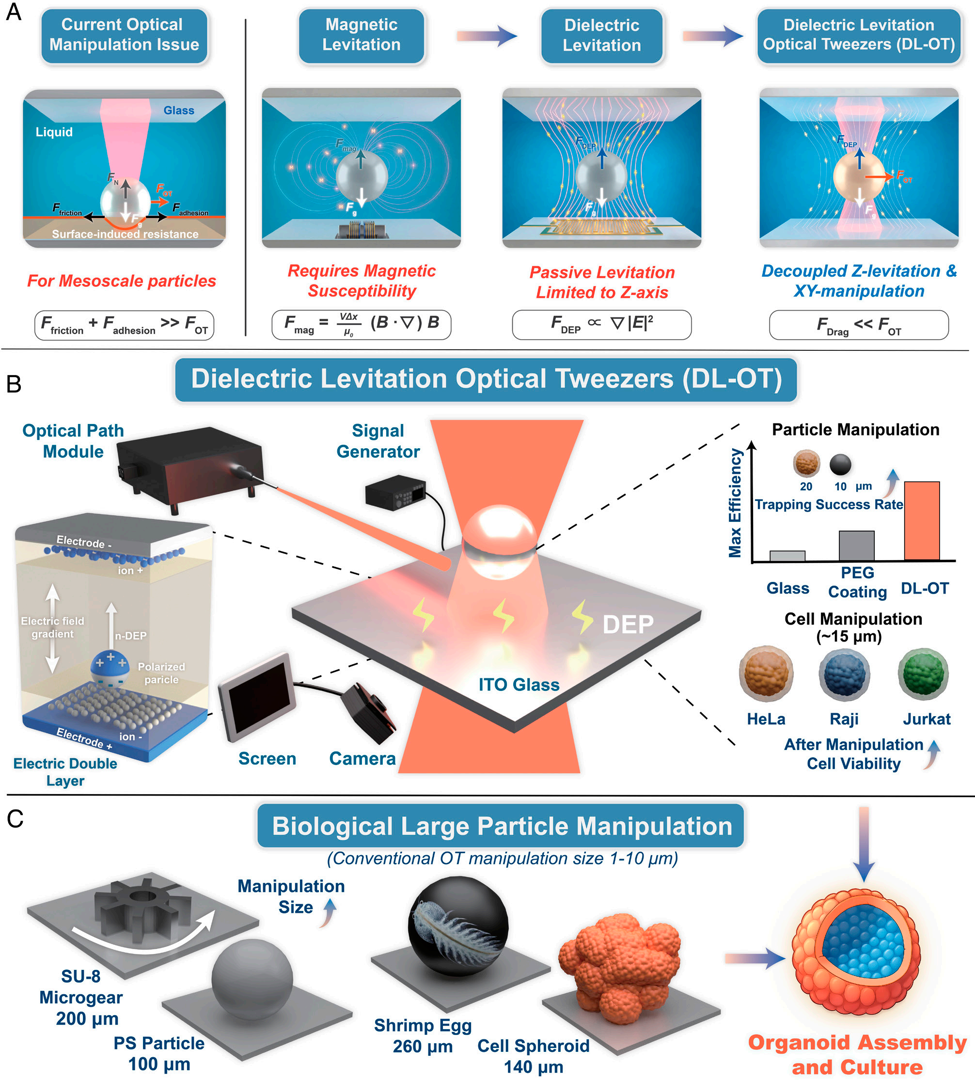
Working principle, system configuration, and schematic of mesoscale biomanipulation using dielectric-levitation optical tweezers (DL-OT; adapted from Fig. 1 of the original paper)
Under the chip design and experimental conditions used in this study, DL-OT achieved stable manipulation of mesoscale objects including 100 μm polystyrene microspheres, 200 μm micromachined gears, and brine shrimp eggs approximately 260 μm in size. The study also validated manipulation of biological samples including multicellular spheroids approximately 50 μm in size and patient-derived organoids approximately 140 μm in size.
The results for the approximately 50 μm multicellular spheroids are representative. On a PEG passive anti-adhesion coating, conventional optical tweezers required approximately 150 mW of laser power to initiate spheroid motion; with DL-OT, stable movement was achieved at approximately 15 mW. The conventional approach produced pronounced spheroid deformation and photothermal damage, whereas DL-OT better preserved structural integrity and cell viability. The relative deformation reported in the paper was greater than 25% and less than 2%, respectively.
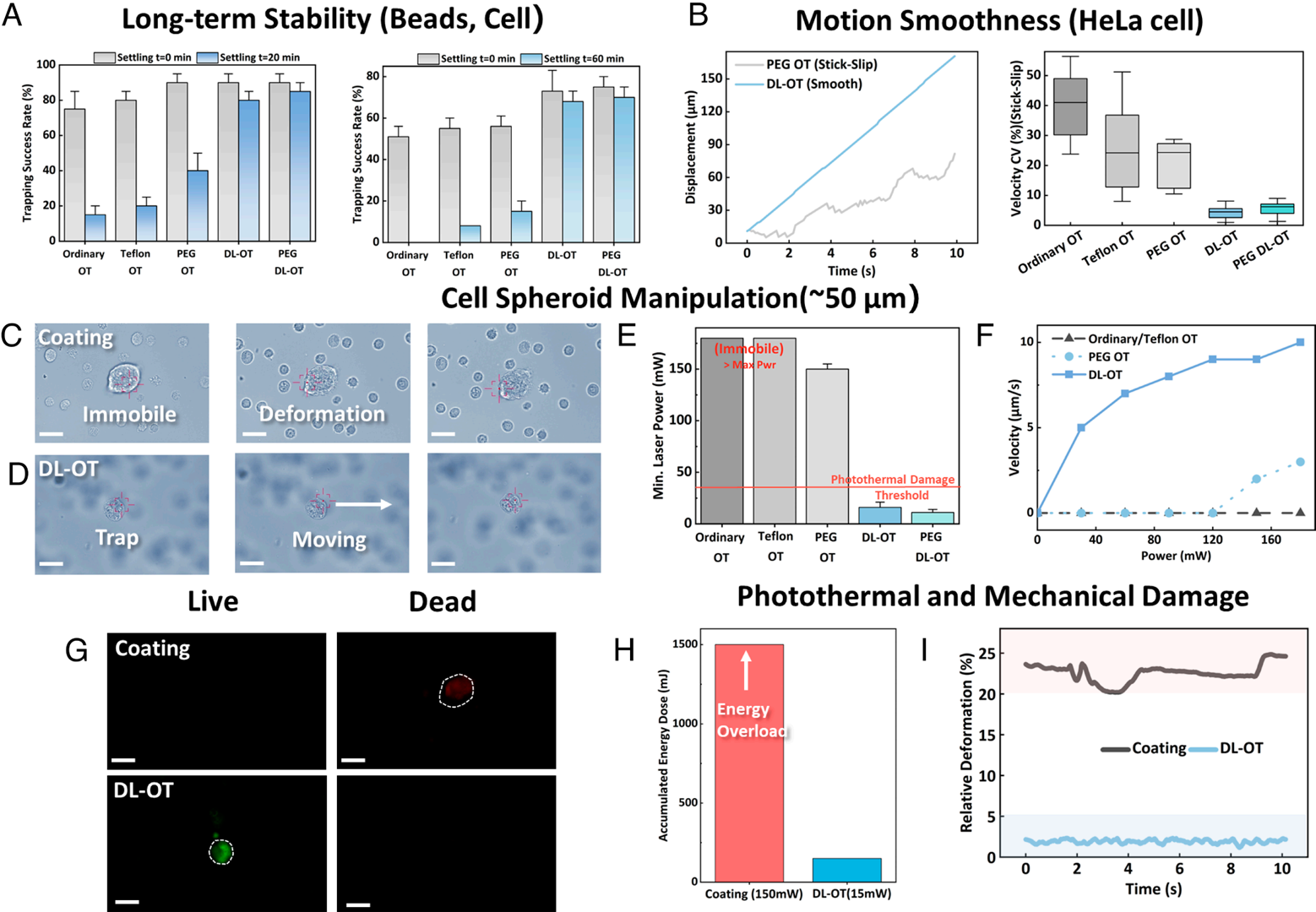
DL-OT substantially reduces the laser power required for multicellular-spheroid manipulation while reducing photothermal and mechanical damage (adapted from Fig. 4 of the original paper)
From Precise Movement to the Assembly of Complex Biological Structures
The researchers further used DL-OT to direct the movement and fusion of two multicellular spheroids. The fused cell aggregate continued to be cultured on-chip while maintaining its three-dimensional structure and favorable cell viability.
The study also achieved gentle transport of patient-derived bladder-cancer organoids approximately 140 μm in size. The manipulated organoids continued to be cultured on-chip, and live/dead staining after 2 days of culture showed that they maintained favorable cell viability.
These results show that the value of DL-OT is not simply that it can make larger objects move. More importantly, it reduces photothermal and mechanical damage during manipulation, preserving the conditions needed for subsequent fusion, culture, and assembly of complex biological structures. It also provides a new technical foundation for organoid research, tissue engineering, and on-chip biomanufacturing.
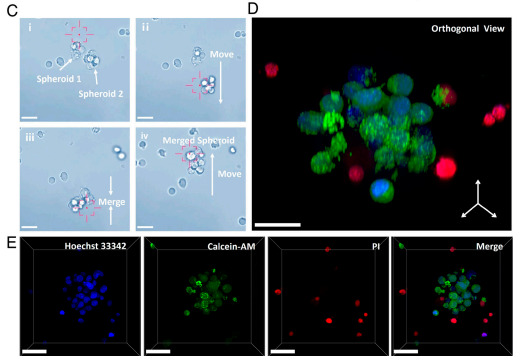
Dielectric-levitation optical tweezers direct the approach, fusion, and on-chip culture of multicellular spheroids (adapted from Fig. 5C–E of the original paper)
Continuing to Explore the Intersection of Micro-/Nanomanipulation and Life Science
Professor Shuaillong Zhang is a professor and doctoral supervisor at Beijing Institute of Technology. He is also a co-founder and Chief Scientist of OptoSeeker Biotech, providing scientific guidance for the company's technology direction, product innovation, and interdisciplinary development.
This work continues Professor Zhang's team's sustained exploration of micro-/nanomanipulation, multiphysics coupling, and life-science applications. It also reflects the continued engagement of OptoSeeker Biotech's scientists at the research frontier.
Congratulations again to Professor Zhang's team and all collaborators.
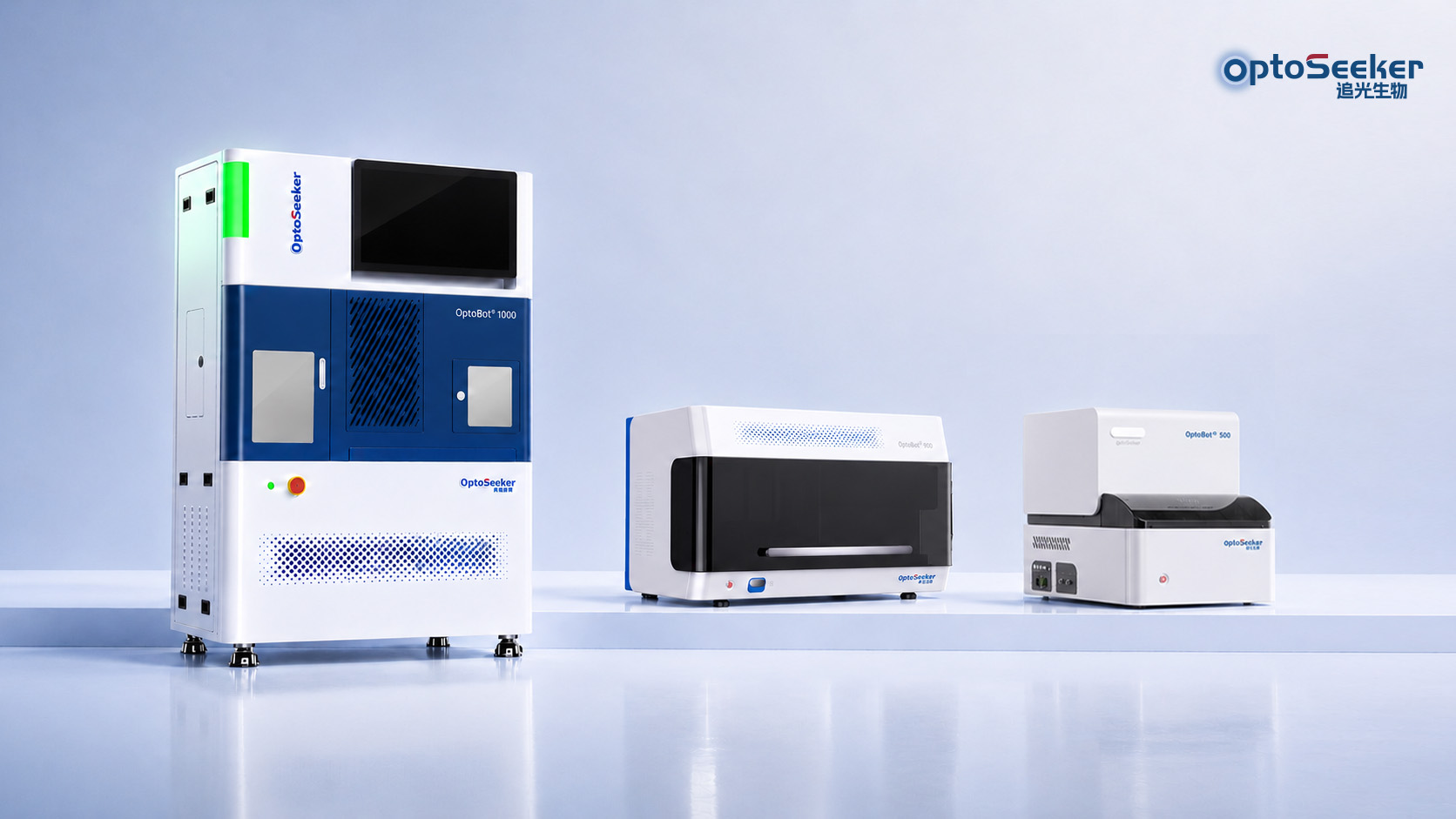
From left to right: OptoBot®1000, OptoBot®800 Series High-Throughput Single-Cell Optofluidic Sorting System, and OptoBot®500 Optoelectronic Tweezer System
Paper Information
Title:Dielectric Levitation Optical Tweezers for Powerful Mesoscale Biomanipulation
Journal:Proceedings of the National Academy of Sciences (PNAS)
Paper link:https://doi.org/10.1073/pnas.2533103123