

The key to long-term live-cell imaging is not simply whether a microscope can produce clear images. It is whether cells can remain in a stable physiological state for hours or even days. Temperature, CO₂, humidity, evaporation, pH, osmolality, and focal drift can all affect the reliability of time-series data.
The OptoGrow®Stage-top Live Cell Incubator System is designed to bring essential environmental control directly to the microscope stage, making dynamic biological processes more continuous, comparable, and suitable for quantitative analysis.
Observing living cells under a microscope is like recording a biological process that unfolds gradually over time. Cell migration, division, interaction, and changes in cellular state rarely occur at a single moment. Much of the most valuable information is found in dynamic changes that take place over several hours or even several days.
This is also where the experiment becomes more complex. The longer the observation period, the more susceptible cells are to environmental fluctuations. The higher the imaging frequency, the more the experiment depends on consistent fields of view, focus, and culture conditions. In long-term live-cell imaging, the variables that most strongly affect data quality are often the ones that appear least conspicuous.
Long-term live-cell imaging therefore needs to answer three questions simultaneously:
Can the cells remain healthy and grow under stable conditions?
Can the same field of view be recorded continuously?
Can data collected at different time points be compared reliably?
In other words, these experiments require more than simply being able to see the cells. They require the ability to maintain stable culture conditions, observe cells over extended periods, and generate comparable data.
Ⅰ.Which Variables Affect Long-Term Live-Cell Imaging?
During short imaging sessions, minor environmental fluctuations may not immediately alter the experimental outcome. When an experiment extends to 12 hours, 24 hours, or longer, however, small variations in temperature, CO₂, and humidity can accumulate and ultimately affect both cellular state and data interpretation.
Temperature influences cellular metabolism, adhesion, and the thermal stability of the microscopy system itself. In long-term time-lapse imaging, temperature instability may not cause an obvious experimental failure. Instead, it may gradually shift cellular behavior, reduce focus stability, or weaken comparability across time points.
CO₂ is closely linked to the buffering system of the culture medium. Many cell culture systems rely on a bicarbonate buffer, and changes in CO₂ concentration can alter medium pH and consequently affect cellular physiology. In experiments involving continuous monitoring of morphology, migration, secretion, or signaling, these environmental disturbances introduce additional uncertainty into data interpretation.
The effects of humidity and evaporation are also frequently underestimated. During extended imaging, changes in medium volume can alter osmolality and local solute concentrations. These effects are particularly pronounced in microchambers, low-volume culture systems, and the peripheral wells of microplates. An apparent change in cellular behavior may therefore result from the experimental treatment—or from gradual drift in the culture environment.
Focal drift is another factor that directly affects image quality. Variations in temperature, liquid volume, and sample position can gradually move the specimen away from the focal plane. For experiments involving trajectory analysis, morphological tracking, fluorescence intensity comparisons, or subcellular imaging, focus stability directly affects the quality of downstream analysis.
Individually, none of these variables is unfamiliar. In a long-term experiment, however, they collectively determine whether the researcher obtains a reliable dynamic dataset or merely a video affected by environmental noise.
Ⅱ.Why Are Conventional Culture Workflows Not Sufficient for Long-Term Observation?
A conventional CO₂ incubator is well suited to maintaining cells over extended periods. Once cells are transferred to a microscope, however, their environmental conditions change. This transition may be acceptable for brief observation, but long-term imaging requires samples to remain within the microscope field of view for extended periods, with environmental control maintained as close to the sample as possible.
The main advantage of a conventional CO₂ incubator is its ability to provide a stable environment for routine cell maintenance and expansion. It does not, however, support continuous microscopic observation. Samples must be transferred between the incubator and microscope, limiting the observation window and introducing additional handling variables.
Short-term observation outside the incubator is straightforward and may be sufficient for rapid imaging, endpoint assays, or brief recordings. As the observation period increases, however, the effects of temperature, pH, and evaporation become progressively more significant. Slowly evolving processes such as cell migration, immune-cell killing, neurite outgrowth, and organoid development cannot always be captured adequately through short observation windows.
A stage-top live cell incubation system addresses this gap by bringing temperature, CO₂, and humidity control directly to the microscope stage. It does not replace the conventional CO₂ incubator. Instead, it extends environmental control into the imaging phase, helping cells remain under stable conditions during observation while reducing variables introduced by sample transfer and prolonged exposure outside the incubator.
Ⅲ.How Does OptoGrow® Bring Culture Conditions to the Microscope Stage?
OptoGrow® is a stage-top live cell incubator system developed by OptoSeeker for long-term live-cell imaging. It integrates a CO₂ mixer, humidifier, and incubation module to provide controlled temperature, humidity, and CO₂ conditions directly on the microscope stage.
The system is compatible with major microscope platforms and professional microscope stages. It supports a range of culture vessels, including culture dishes, chambered slides, culture flasks, and multiwell plates, allowing it to be incorporated into existing live-cell imaging workflows.
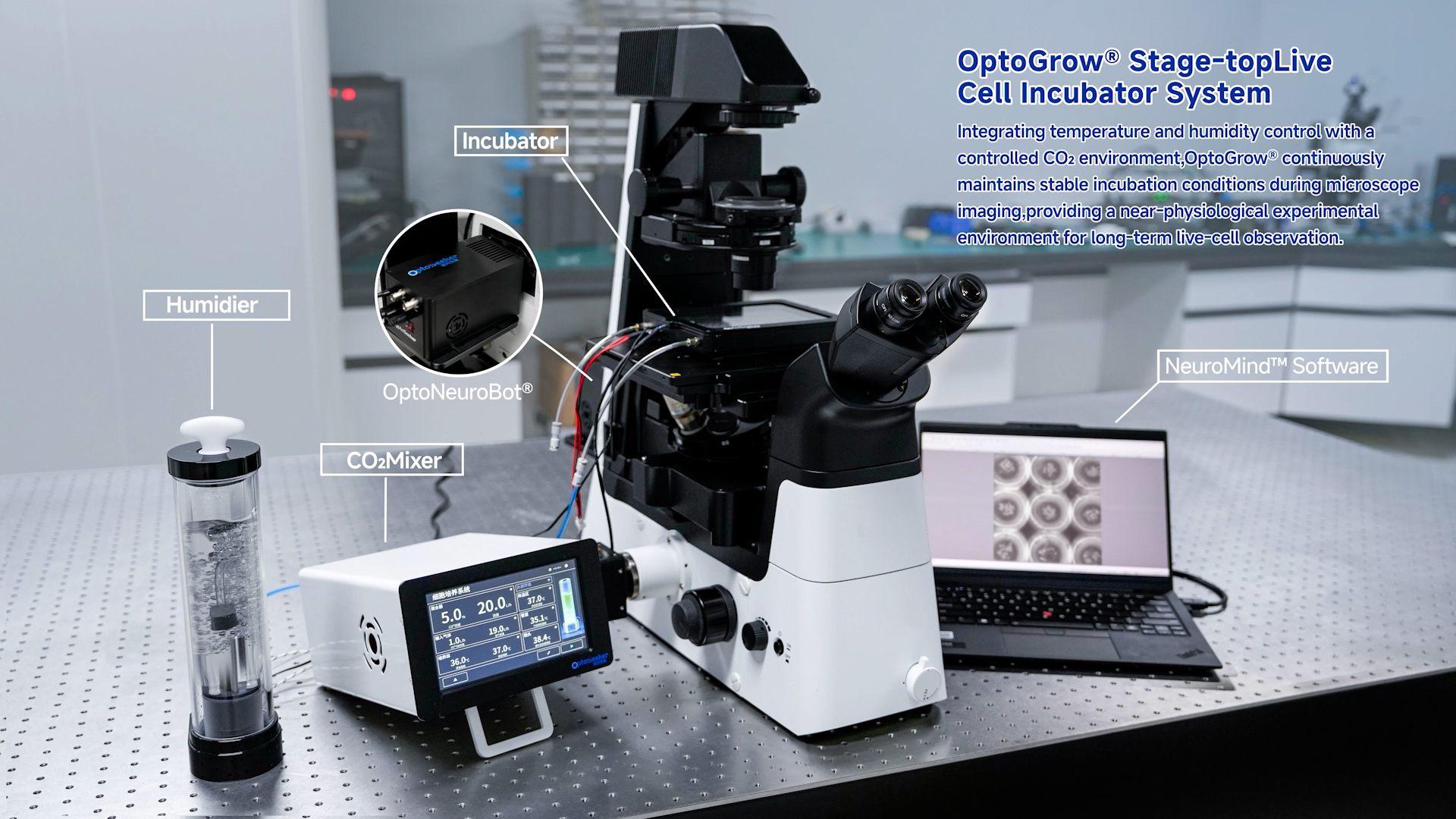
OptoGrow® Stage-top Live Cell Incubator System: Module Overview
For long-term imaging, specifications need to be understood in the context of experimental variables. The key question is how each control capability affects cellular condition, the culture environment, and the quality of time-series data.
OptoGrow® provides a system temperature control range of 25–45 °C, with sample closed-loop temperature control accuracy of ±0.1 °C.
Stable temperature control is important not only for maintaining cellular metabolism, but also for supporting the thermal stability of the microscope system and sample plane. The longer the observation period, the more fundamental temperature control becomes to overall data quality.
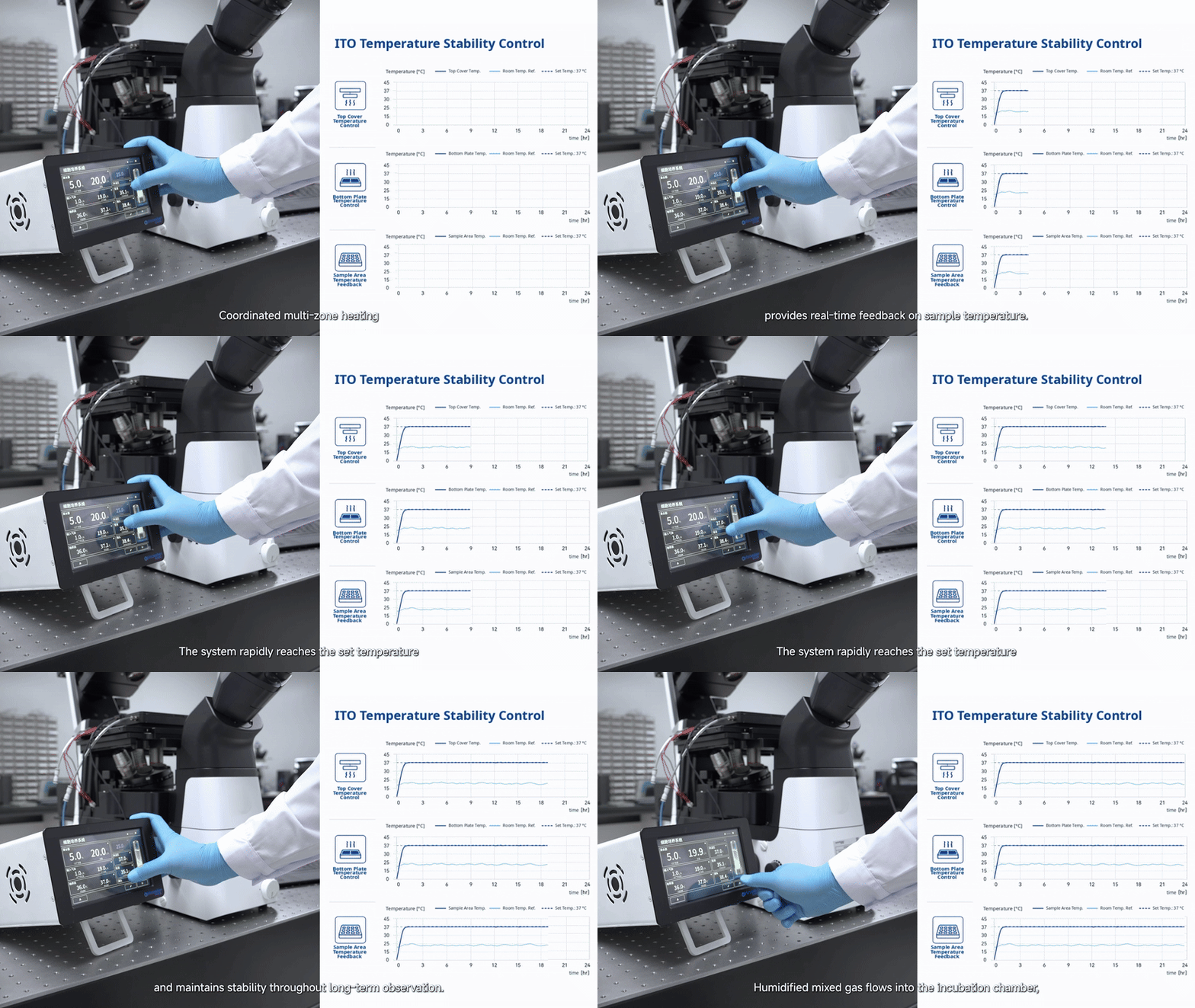
OptoGrow® ITO Temperature Stability Control
The system incorporates a digital gas sensor and supports a CO₂ concentration control range of 0–20%.
This capability is primarily intended for cell culture systems that depend on CO₂ and bicarbonate buffering. By maintaining a controlled CO₂ environment, the system helps stabilize medium pH and reduce disturbances caused by moving samples out of a conventional incubator.
OptoGrow® provides closed-loop humidity control across a range of 20–99%, helping reduce the risk of medium evaporation during prolonged observation.
This is particularly important for low-volume culture, microchambers, multiwell plates, and extended time-lapse imaging. Evaporation-induced changes in osmolality and solute concentration can directly affect cellular condition and experimental outcomes.
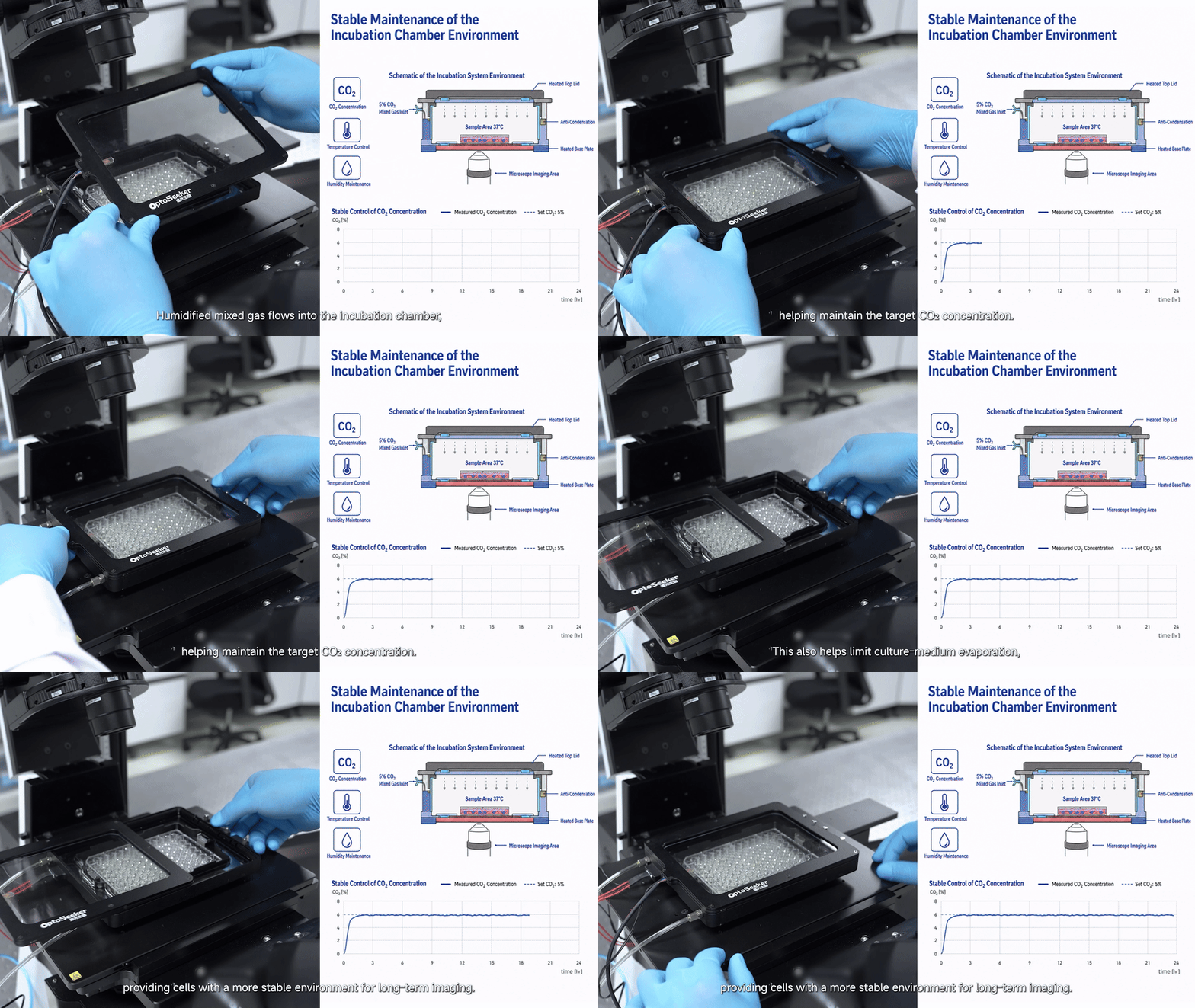
Stable Environmental Control within the OptoGrow® Incubation Chamber
The incubation module features a large bottom opening to accommodate objective access. Together with PID control and continuous output regulation, the system helps reduce changes in imaging conditions associated with temperature fluctuations and variations in liquid volume.
Focus stability should nevertheless be interpreted carefully. It is affected by multiple factors, including the microscope, stage, sample thickness, medium volume, and autofocus system. OptoGrow® supports long-term focus stability by maintaining a more stable environmental and structural interface around the sample; it does not independently eliminate every possible source of focal drift.
OptoGrow® supports culture dishes, chambered slides, culture flasks, multiwell plates, and other commonly used culture vessels.
This compatibility allows laboratories to integrate the system into established imaging workflows without completely redesigning their experimental procedures or adopting an entirely new closed culture format.
For endpoint assays, brief imaging sessions, or samples that do not require controlled CO₂ conditions, conventional culture and short-term observation may already be sufficient. OptoGrow® is most relevant to experiments requiring continuous observation over several hours or days, particularly when cellular condition, environmental stability, and time-series comparability are critical.
Ⅳ.From Endpoint Observation to Continuous Dynamic Readouts
The value of long-term live-cell imaging lies in its ability to convert processes that would otherwise be inferred from endpoint measurements into continuous, traceable, and comparable dynamic data.
Cell migration, morphological change, neurite outgrowth, immune-cell killing, multicellular aggregate formation, and organoid development all have a strong temporal dimension.
When the culture environment is sufficiently stable, researchers can distinguish biological changes from artifacts caused by sample transfer, evaporation, pH fluctuation, or focal drift with greater confidence.
This is the significance of combining OptoGrow® with a microscopy system. The microscope records cellular behavior, while the stage-top incubation system maintains the sample environment. Together, they extend live-cell experiments from isolated endpoint observations to continuous dynamic readouts.
Ⅴ.Integration with OptoNeuroBot®: From Dynamic Optical Control to Long-Term Observation
In some experiments, researchers need to do more than observe cells. They may also need to use light to alter the spatial environment, molecular state, or signaling activity of the cells, and then continuously monitor the resulting response.
These experiments require precise control over the spatial location, timing, and intensity of light stimulation, followed by stable culture conditions for long-term tracking.
The OptoNeuroBot® Patterned Illuminator uses a Digital Micromirror Device (DMD) to project patterns, trajectories, boundaries, arrays, and gradients onto the sample plane. With multiple wavelengths, independent control of multiple regions of interest, time-programmed illumination, and structured light pattern design, the system supports experiments requiring spatially patterned optical control.
Representative applications include:
-
Microtopography construction
-
Fabrication of 3D culture structures
-
Patterned surface modification
-
Light-induced biological studies
-
Optogenetics
-
Protein liquid–liquid phase separation research
The value of this integration becomes particularly clear in dynamic optical-control experiments.
In studies of light-inducible protein behavior, researchers may use a defined wavelength and patterned illumination to observe changes in protein localization, molecular interactions, or downstream signaling. In optogenetics and neuroscience, researchers may stimulate a specific region during a defined time window and then monitor neuronal activity, neurite outgrowth, network connectivity, or signaling changes.
These experiments depend on continuous observation before, during, and after stimulation. A single endpoint rarely captures the full biological response.
OptoGrow® maintains the temperature, humidity, and CO₂ conditions required for prolonged cell culture and imaging on the microscope stage. OptoNeuroBot® provides spatially and temporally controlled optical input, while OptoGrow® provides the culture environment required for extended observation.
Together, the two systems connect the experimental workflow:
-
Define the illumination region, pattern, and timing.
-
Apply programmable optical stimulation.
-
Maintain the cells under controlled culture conditions.
-
Perform continuous live-cell imaging.
-
Analyze cell migration, morphology, fluorescence signals, neurite outgrowth, or collective behavior.
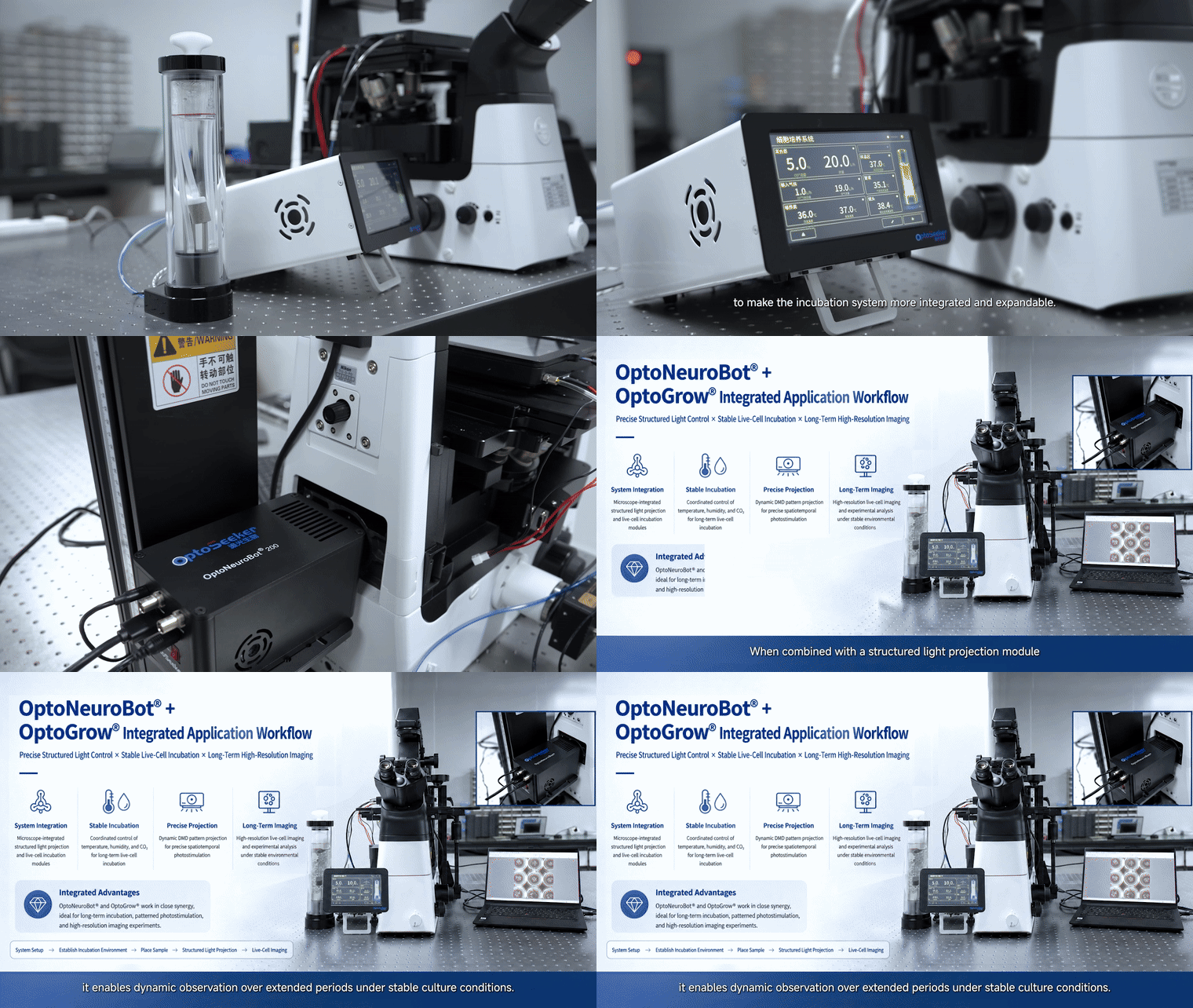
Integrated Workflow of OptoGrow® and OptoNeuroBot®
The combined value of OptoGrow® and OptoNeuroBot® extends beyond simply placing a patterned illumination module beside a live-cell incubation system.
The integration is designed for a specific class of dynamic experiments: light is first used as a programmable perturbation, and long-term live-cell imaging is then used to record the resulting response.
For studies of light-inducible protein behavior, optogenetic neural modulation, neuronal signaling pathways, programmable microenvironments, and cell behavior, this combination brings optical intervention and dynamic observation into a continuous experimental workflow.
Ⅵ.Which Experiments Benefit Most from a Stable Stage-Top Culture Environment?
OptoGrow® is designed for experiments that require continuous observation of changes in living cells under the microscope.Researchers can assess whether a stable stage-top culture environment is needed by considering three conditions:
-
The observation period is long.
-
The cells are sensitive to environmental changes.
-
Data must be compared across multiple time points.
In cell migration, adhesion, and scratch-wound assays, researchers typically measure migration speed, direction, trajectory, and morphological changes.OptoGrow® supports continuous observation over hours or days, enabling migration and adhesion processes to be recorded more completely.Organoid and 3D culture studies often involve monitoring aggregate growth, morphological maturation, edge invasion, localized necrosis, and drug response.
These processes typically develop slowly and depend strongly on stable culture conditions. OptoGrow® maintains temperature, humidity, and CO₂ conditions within the microscope field of view to support long-term morphological tracking.
A single endpoint cytotoxicity measurement cannot fully describe how immune cells approach, contact, kill, or fail to eliminate tumor cells.
Live-cell co-culture imaging over periods of approximately 12–72 hours can convert immune-cell killing into traceable spatiotemporal data, capturing interactions that are otherwise lost in endpoint measurements.
Neurite outgrowth, axon guidance, network connectivity, and calcium signaling all unfold over time.
When combined with patterned illumination, researchers can further examine how spatially and temporally controlled optical stimulation affects neuronal morphology, network formation, and functional signaling.
Cell proliferation, cell death, morphology, migration, and multicellular aggregate responses may change continuously following drug treatment.
A stable stage-top culture environment reduces interference from sample transfer and environmental fluctuations, improving the comparability of time-series data.
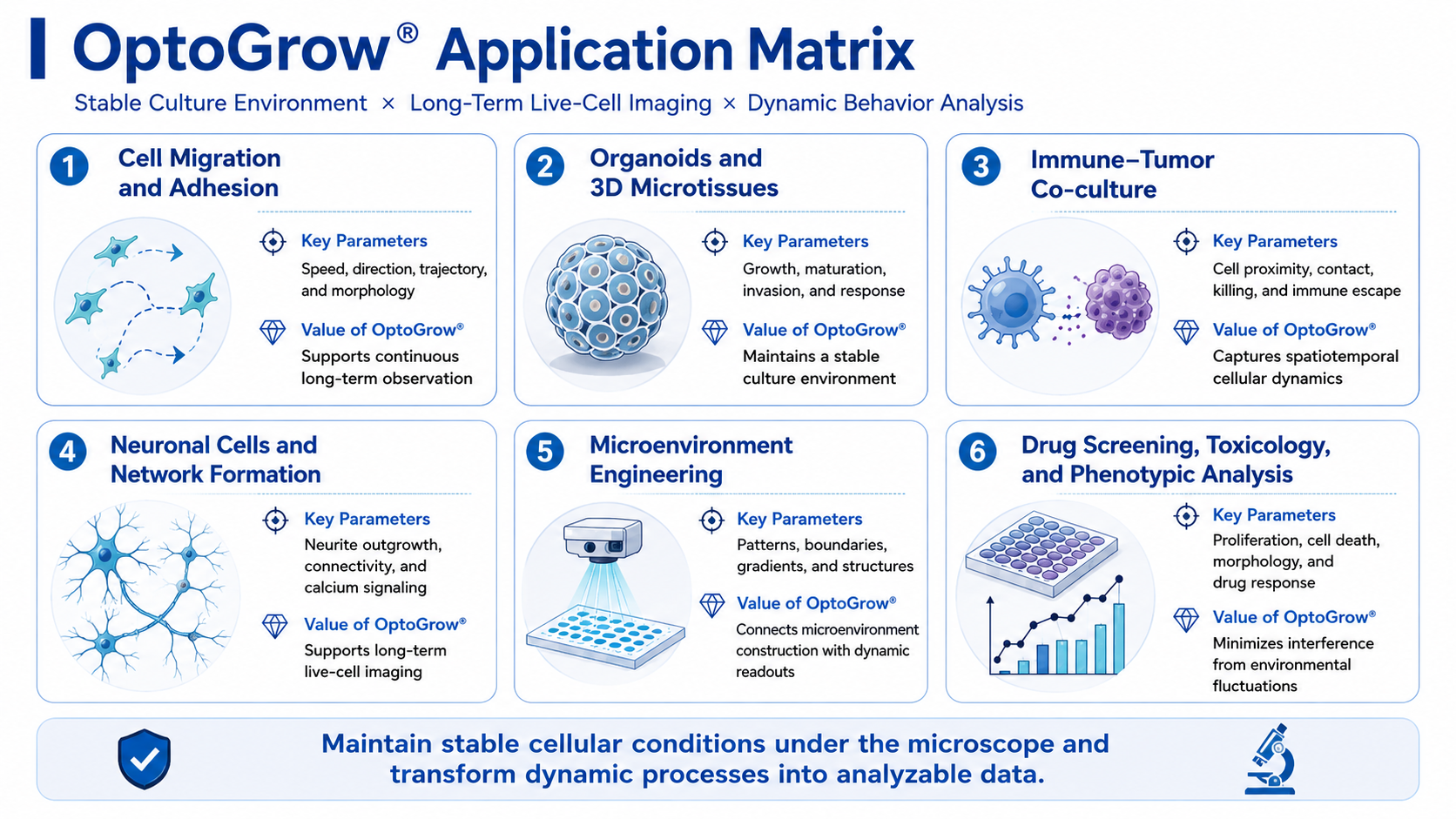
OptoGrow® Application Matrix
Conclusion: Turn Dynamic Processes into Reliable Data
The main challenge in live-cell imaging is not obtaining a single visually compelling image. It is maintaining cellular condition, controlling the culture environment, stabilizing imaging conditions, and ensuring that each time point can be compared under a consistent experimental framework over hours or even days.
As research expands from two-dimensional cell culture to 3D microenvironments, organoids, immune-cell co-culture, and programmable microenvironments, the stability of the stage-top culture environment increasingly affects both data quality and biological interpretation.
OptoGrow® extends environmental control into the microscopy phase, helping cells remain under stable conditions throughout observation and enabling dynamic biological processes to be converted into analyzable and reproducible experimental data.