


Editor's Note
As the AI for Biology wave moves beyond computational modeling and algorithmic exploration into real-world laboratories, the value of foundational life science hardware and systems engineering is being redefined.Recently, 36Kr, a leading Chinese technology and venture capital media platform, published an in-depth industry analysis examining the evolution of biological experimental infrastructure. The article explores key dimensions including multidisciplinary systems engineering, the reuse of core technologies, lean organizational management, and commercial deployment, using OptoSeeker as a case study. As the article highlights, biological experimentation in the AI era requires more than intelligent models capable of reasoning. It also demands a robust physical infrastructure capable of precisely manipulating microscopic samples and continuously generating high-dimensional primary experimental data.We are pleased to republish the article in full and invite readers interested in life science technologies and the real-world applications of AI to explore these developments with us.
This article was originally published by 36Kr. Click the link at the bottom to read the original report.
As artificial intelligence rapidly enters biology laboratories, long-overlooked capabilities in foundational hardware and systems engineering are beginning to reshape how the industry assesses value.
Breakthroughs in protein structure prediction, molecular design, and drug discovery have made AI for Biology a major focus of technology investment. Yet as AI models generate an ever-growing number of scientific hypotheses, a critical bottleneck is shifting to the physical world: who will carry out the wet-lab experiments needed to validate them?
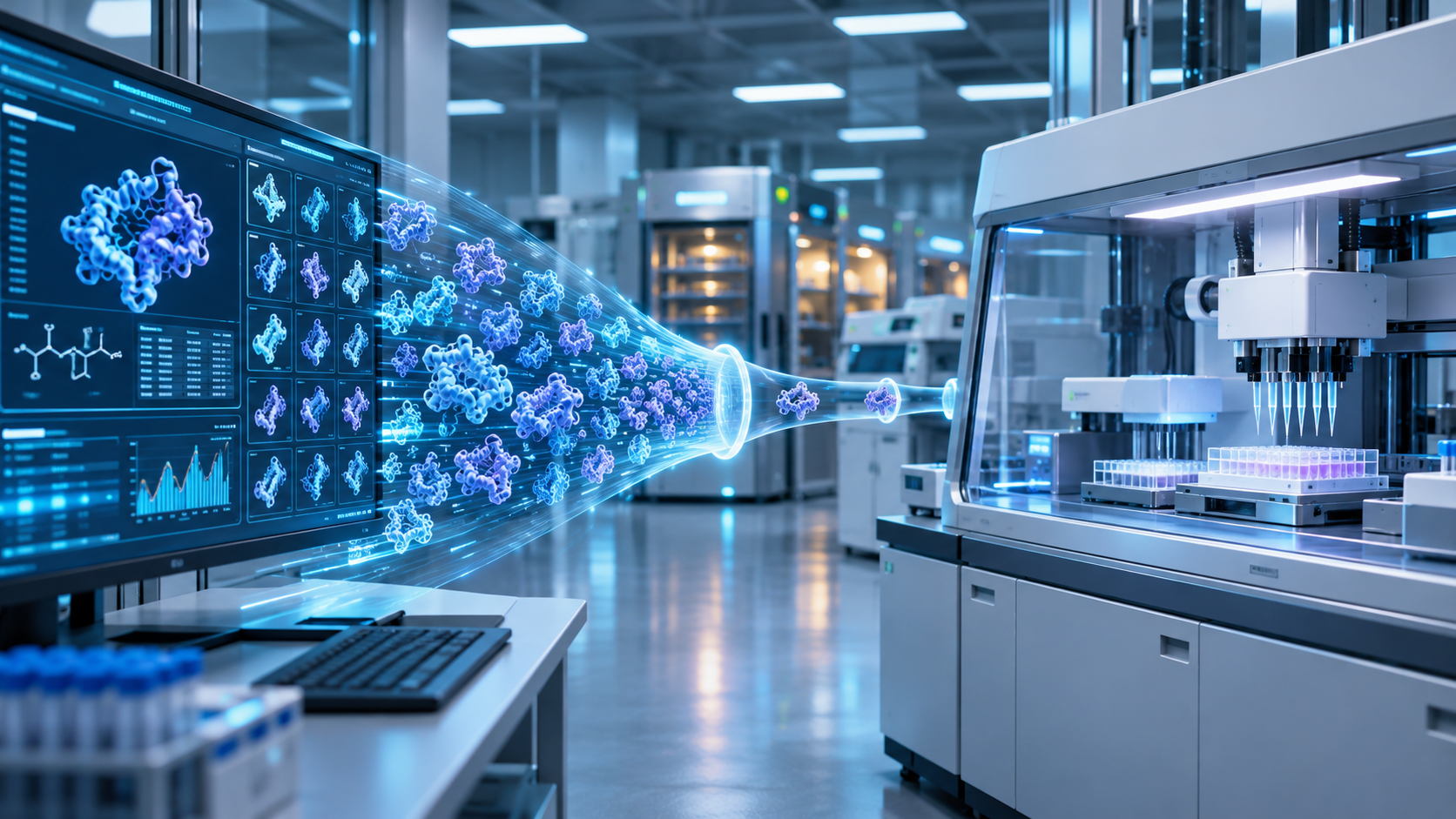
AI can rapidly generate protein structures and candidate molecules, but real-world biological experiments remain constrained by experimental throughput, detection efficiency, and physical sample-handling capabilities.
An increasingly clear industry consensus is emerging: in the next phase of AI-driven biotechnology, the bottleneck will no longer be limited to computing power and algorithms. It will also be the capacity to execute experiments at scale. An autonomous laboratory capable of sustaining a commercially viable closed-loop workflow must overcome three engineering challenges: scalable execution, system versatility, and the generation of high-quality data.
In other words, AI needs more than models that can reason. It also needs physical infrastructure capable of executing experiments precisely, generating reliable primary data, and feeding results back into models in real time. Competition in life sciences is extending beyond algorithms to experimental execution.
This shift is also creating new opportunities for life science instrumentation companies. Founded in Shenzhen in 2023, OptoSeeker is building on its independently developed core instruments to explore intelligent wet-lab solutions for life science research. By combining AI foundation models, laboratory automation, coordinated hardware and software, and data capabilities, the company offers an example of how a deep-tech enterprise can extend its existing strengths into new applications.
OptoSeeker has traditionally been recognized as a developer of advanced life science instruments. But a closer look at its multidisciplinary team, interconnected technologies, and operating model reveals a set of capabilities that extends beyond instrument development and could underpin future intelligent laboratory systems.
01 丨 From Precision Instruments to Autonomous Laboratories
Building an AI-powered autonomous laboratory is far more complex than having software control a few robotic arms.
A truly closed-loop autonomous laboratory must connect experimental design, automated execution, process monitoring, and data analysis. The system needs to accommodate complex biological reactions and precisely manipulate microscopic samples, while keeping its optics, chips, sensors, and software stable and reproducible as they operate in close coordination. At its core, this is a demanding multidisciplinary systems-engineering challenge—the same kind of challenge that defines the barriers to developing advanced life science instruments.
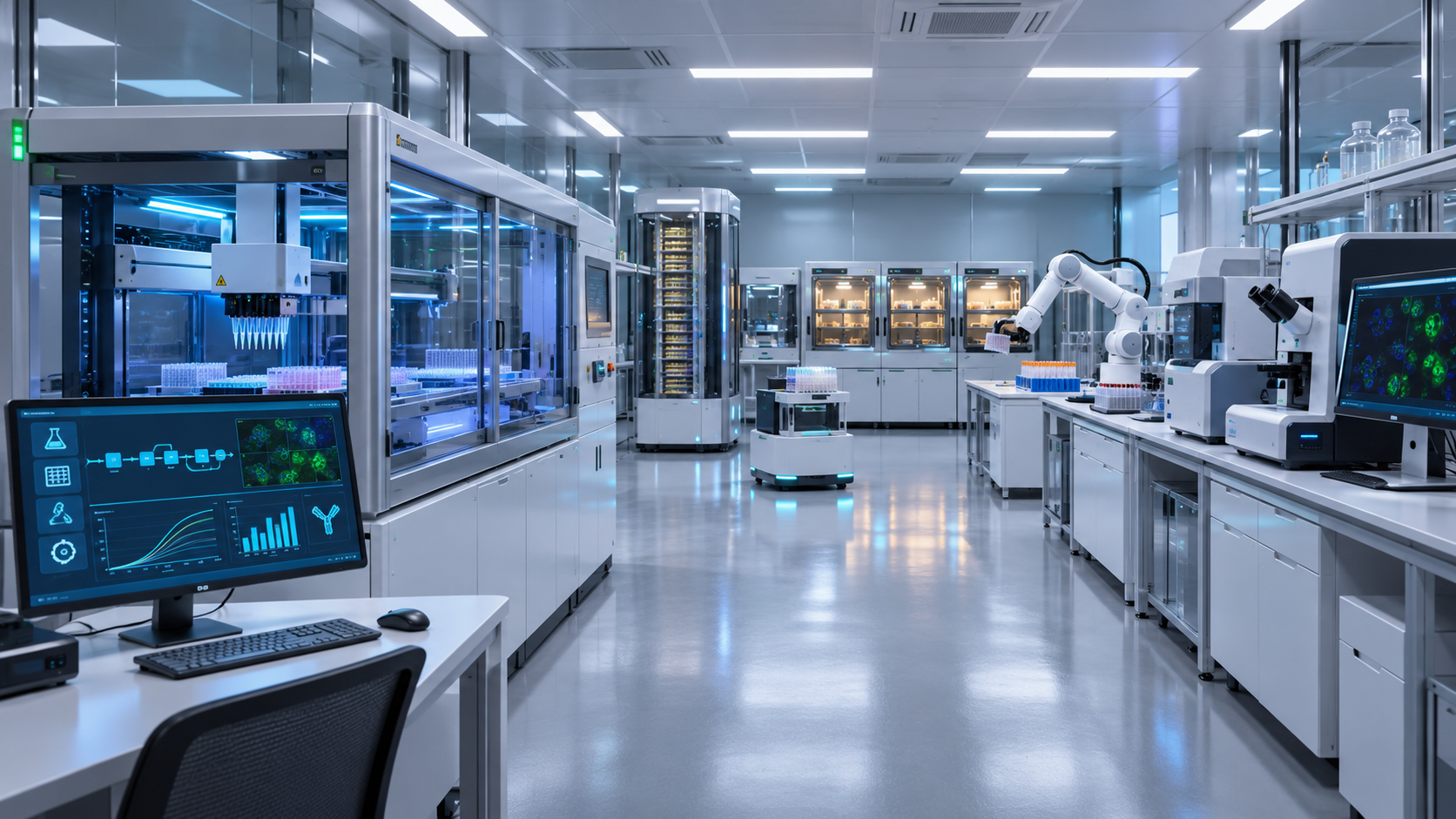
Conceptual illustration of an AI-powered autonomous laboratory: AI coordinates automated instruments for biological sample processing, experiment execution, data acquisition, and analysis. Results inform the next experimental design, creating a closed loop of design, execution, analysis, and optimization across computational and wet-lab workflows.
OptoSeeker brings together experience in frontier research and industrial engineering. Its founding and core scientific team includes researchers with backgrounds at Beijing Institute of Technology, Southern University of Science and Technology, and Jinan University, with expertise spanning optoelectronic manipulation, microfluidics, and life sciences. Key management and engineering personnel also bring experience from Danaher, a global leader in life sciences and scientific instrumentation, including industrial product development and lean management. Together, these backgrounds help connect scientific principles, experimental needs, and practical engineering implementation.
Consider the company's commercially available flagship product, the OptoBot®1000 high-throughput single-cell optofluidic platform. It integrates optoelectronic tweezers (OET), microfluidic chips, microscopic imaging, semiconductor technologies, automation controls, and biological workflows to automate cell loading, isolation, culture, observation, screening, and recovery. At the microscale, the optical system and microfluidic chip must work together with high precision, while cell viability is maintained. The software must coordinate multiple hardware modules in real time; even small deviations can affect experimental outcomes.
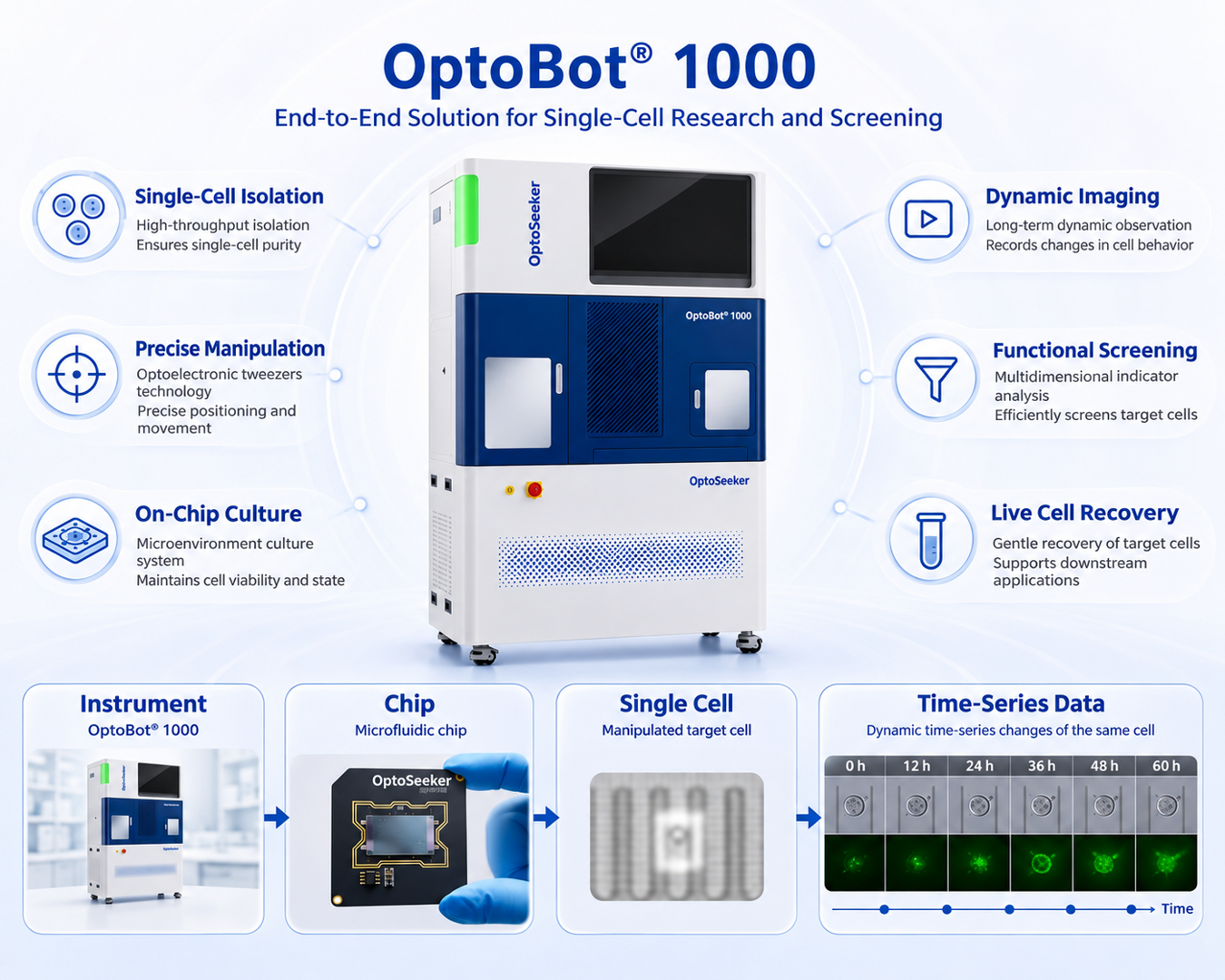
OptoBot®1000: Overview of the Single-Cell Research and Screening Workflow
Since its founding, OptoSeeker has introduced the OptoBot®, DropletBot®, and OptoNeuroBot® product lines, drawing on core technologies such as optoelectronic tweezers, digital microfluidics, and patterned light projection. Three capabilities developed through its work on advanced instruments closely align with the requirements of biological experimental infrastructure in the AI era:
First, the ability to integrate and coordinate complex multidisciplinary systems. Whether building a sophisticated instrument or an intelligent laboratory, engineers must address interfaces between devices, operating sequences, system stability, and exception handling. OptoSeeker's experience in integrating optical, electronic, mechanical, microfluidic, and software subsystems has the potential to transfer across products and application scenarios.
Second, the ability to turn complex biological experiments into automated workflows. An experiment performed manually by a researcher is not necessarily easy for a machine to reproduce consistently. In developing its instruments, OptoSeeker has closely integrated software control, workflow configuration, and automated execution, translating delicate, experience-dependent operations into explicit machine-control rules. This is a key foundation for advancing laboratory automation.
Third, the ability to monitor microscopic states and acquire high-quality primary data. In the AI era, laboratory instruments serve not only as experimental tools but also as data-acquisition systems. OptoSeeker's platforms combine microscopic imaging, cell-state tracking, and experimental process recording. In single-cell research in particular, these capabilities can link dynamic cellular changes and functional responses to specific experimental conditions, generating high-dimensional time-resolved data that are difficult to capture using conventional methods. Such data are valuable inputs for training and refining biological AI models.
Automating a single precision instrument is, of course, not the same as coordinating multiple devices for sustained, independent operation across an entire autonomous laboratory. Nevertheless, both rely on the same underlying competencies in multidisciplinary integration, microscale manipulation, automated execution, and data acquisition.
OptoSeeker has also begun exploring a closed-loop architecture that connects an 'AI brain' with physical laboratory systems. The company is advancing the development of a proprietary AI agent for life science applications, with the aim of integrating AI-based scientific reasoning and experiment planning with precision experimental instruments. This represents a forward-looking step toward more autonomous laboratories.
02 丨 Engineering Complexity: From R&D to Product Delivery
Deep-tech startups often face lengthy development cycles and tightly coupled technical challenges. For an early-stage team, a breakthrough in a single technology is only the beginning. The more difficult task is to advance complex engineering programs with limited resources and turn accumulated expertise into organizational capabilities that can be repeated and scaled.
Across its products and use cases, OptoSeeker is working to develop reusable software, control systems, engineering modules, and R&D practices. Although optoelectronic tweezers, digital microfluidics, and patterned light projection serve different applications, they share important foundations in optical control, electronics, chip technologies, and low-level software. Building on these common elements, the company is progressively expanding its experience in cross-device integration, experimental-method adaptation, and customer delivery for automated workstations and integrated laboratory workflows.
This development approach is supported by OptoSeeker's investment in systematic engineering practices and organizational capabilities:
Adopting lean management principles. Drawing on established practices from Danaher and other leading scientific instrument companies while adapting them to a startup environment, OptoSeeker has introduced visual project management, 5S workplace organization, and continuous improvement into daily operations. These practices help standardize R&D, manufacturing, and quality management, reduce reliance on individual experience, and make complex engineering projects more controllable and repeatable.
Building an AI-native operating model. The team is embedding AI into R&D support, knowledge management, process redesign, and cross-functional collaboration, using a lean organizational structure to support complex engineering development with greater efficiency.
The next generation of intelligent experimental infrastructure will require sustained coordination across disciplines and continuous integration of instruments, control systems, software, and biological applications. The combination of reusable core modules, lean management, and an AI-native organization could become an important competitive advantage as OptoSeeker enters its next stage of development.
03 丨 From Technology Development to Commercial Deployment
Ultimately, the strength of a company's technologies and engineering systems must be demonstrated through real customer deliveries, industry partnerships, and continued investor support.
OptoSeeker has progressed from proof-of-concept prototypes to production-ready instruments and has established in-house R&D and manufacturing capabilities for hardware, software, and microfluidic chip consumables. According to publicly disclosed information, its instruments have been delivered and installed at research organizations affiliated with Peking University, Tsinghua University, Shanghai Jiao Tong University, the University of Science and Technology of China, and the Chinese Academy of Sciences, as well as at selected biopharmaceutical companies. Applications span single-cell manipulation, digital microfluidics, and patterned light projection, with some products also deployed at research institutions outside China.
Beyond individual instrument sales, the recognition of OptoSeeker's underlying platform by partners across the industry value chain is particularly significant. To advance functional single-cell screening and the integration of multi-omics data, the company has established strategic collaborations with several industry players. It is working with BioMap, a pioneer in AI foundation models for the life sciences, to explore AI-enabled high-throughput single-cell screening. It is also collaborating with MGI Tech on linking single-cell phenotypic data with corresponding genomic sequencing data. In September 2026, OptoSeeker signed a strategic cooperation agreement with AlphaX Bio to advance drug-discovery-oriented functional single-cell screening services and innovation in spatial omics instrumentation using the OptoBot®1000 platform. These partnerships—spanning AI models, sequencing platforms, and omics services—demonstrate the potential of OptoSeeker's instruments to connect different steps in real-world research workflows.
OptoSeeker's Strategic Partnerships with MGI Tech and BioMap
The company has also attracted successive rounds of investment. After securing tens of millions of RMB in angel funding in October 2023 and commencing operations, OptoSeeker completed an additional angel-plus round worth tens of millions of RMB in June 2025, led by Innoangel Fund. In October 2026, the company announced a Pre-A financing round of more than RMB 50 million, led by Shenzhen Capital Group (SCGC). According to the announcement, the new funding will support core product development and engineering, validation of application scenarios, and exploration of AI-driven technical service models.
04 丨 Opportunities for Emerging Deep-Tech Companies
As interest in AI for Biology grows, larger companies are accelerating the integration of AI models, robotic arms, automated workstations, and data systems. Where can emerging scientific instrument companies establish a competitive position in a market shaped by industry giants?
One possible answer is to develop and control the core measurement and precision-manipulation technologies themselves, rather than relying entirely on externally sourced instruments linked together by robotic arms.
A common approach to laboratory automation today is systems integration: purchasing finished instruments from different vendors and connecting them with robotic arms or track-based transport systems. Yet in real biological experiments—especially live-cell functional analysis and microscale reactions—this assembled approach can encounter substantial limitations in performance and efficiency.
For OptoSeeker, the immediate priority is to continue strengthening its core instrument products and customer delivery capabilities. Building on that foundation, the company plans to connect its proprietary measurement systems with laboratory automation and software, exploring more comprehensive intelligent wet-lab solutions for AI for Biology.
As customers demand greater experimental efficiency, better data quality, and smoother integration between workflow steps, autonomous laboratory solutions that operate reliably in defined use cases, produce trustworthy data, and address real R&D needs may generate significant value. Through continued application validation and customer collaboration, OptoSeeker can gradually build a differentiated position in the experimental infrastructure supporting AI-driven biology.
As AI for Biology moves beyond algorithm development toward deployment in real laboratories, the criteria for assessing life science instrumentation companies are changing. Companies that control core measurement and experimental execution technologies—and combine scientific insight, disciplined engineering, and effective organizational capabilities to turn complex biology into efficient, reliable, and data-connected physical systems—will be better positioned to play a central role in the next phase of life science innovation.
Click Here to Read the Original Article